Sets the language-development focus, interpretive and expressive modes, Key Language Uses, and proficiency-responsive ELD 1–2 supports.
WIDA framework →FREE NEWCOMER RESOURCE · UNIT 01
All About Me
A five-day identity and language unit for grades 6–8, WIDA ELD 1–2.
5 × 45-minute lessonsEnglish + Spanish supportPrintable student tasks
Teacher overview
This unit creates a safe, structured way for newcomers to practice foundational English. Students may share only information they are comfortable sharing. Allow drawing, pointing, home-language rehearsal, or oral answers.
WIDA differentiation: ELD 1 students point, match, copy key words, rehearse orally, and complete one short frame. ELD 2 students identify details, produce simple sentences, and connect ideas with and or because.
WIDA alignment
- ELD Standard 1: Social and Instructional Language
- Key Language Uses: Narrate and Inform
- Interpretive: read and view
- Expressive: speak and write
Research foundation
WIDA guides language goals and proficiency supports. CAST UDL guides multiple ways to perceive and respond. Explicit multisensory word routines are OG-informed, but are not presented as a complete OG phonics intervention. Federal newcomer guidance supports asset-based, age-respectful participation and home-language access.
RESEARCH-BASED DESIGN
Every scaffold has a purpose.
The frameworks work together, but they are not interchangeable. This map shows what each one contributes to the unit.
Supports multiple ways to perceive information and respond through visuals, oral rehearsal, bilingual clarification, pointing, drawing, speaking, and writing.
UDL Guidelines →Adds brief, explicit multisensory practice: teacher modeling, syllable awareness, tracing, saying, and writing. This is not a complete OG phonics intervention.
About OG →Centers an asset-based, welcoming, age-respectful environment with home-language access and several supported ways to participate.
Open official toolkit PDF →Complete printable packet24 pages · teacher guide · five lessons · 15 student handouts · assessment
Download PDFDaily teaching routine
Say the target sentence while pointing to a visual. Give your own safe example.
Students rehearse with a partner using the frames.
Read aloud twice. Students circle familiar words and answer from the text.
Students complete the task and add it to their profile folder.
Day 1
My Name and Identity
Learning target: I can introduce myself using my name, age, and country.
Language objective: Students will share personal information by using “My name is…,” “I am…,” and “I am from….”
Vocabulary
namenombre
ageedad
countrypaís
studentestudiante
Do Now · 5 minutes
Draw a small picture of yourself. Write your name under the picture.
Mini lesson · 8 minutes
- Post and read the learning target.
- Teach vocabulary with gestures or quick sketches.
- Model the sentence frames with your own example.
My Name and Identity
Hello! My name is Ana. I am 13 years old. I am from the Dominican Republic. I am a student. I speak Spanish and I am learning English.
Read and answer.
- What is the student’s name?
- How old is Ana?
- Where is Ana from?
- What language does she speak?
My work
My name is ____. I am ____ years old. I am from ____. I am a student.
Write or draw here.
Exit ticket
Write two complete sentences about yourself.
Day 2
My Family and Home
Learning target: I can identify people in my family and describe where I live.
Language objective: Students will describe family and home by using “I live with…” and “This is my….”
Vocabulary
familyfamilia
mothermadre
fatherpadre
sisterhermana
brotherhermano
homehogar / casa
Do Now · 5 minutes
Circle the people who may be in a family: sister · teacher · brother · mother · friend.
Mini lesson · 8 minutes
- Post and read the learning target.
- Teach vocabulary with gestures or quick sketches.
- Model the sentence frames with your own example.
My Family and Home
Luis lives in Boston with his mother, grandmother, and two brothers. His family speaks Spanish at home. Luis helps his grandmother and plays soccer with his brothers.
Read and answer.
- Where does Luis live?
- Who lives with Luis?
- What language does the family speak?
- What does Luis do with his brothers?
My work
Draw the people who are important to you. Label each person. Write: I live with ____. This is my ____.
Write or draw here.
Exit ticket
Complete: One important person in my life is my ____.
Day 3
My Languages and Strengths
Learning target: I can name my languages and one personal strength.
Language objective: Students will explain abilities by using “I speak…,” “I can…,” and “I am good at….”
Vocabulary
languageidioma
speakhablar
learnaprender
strengthfortaleza
helpfulservicial
creativecreativo/a
Do Now · 5 minutes
Write or draw one thing you can do well.
Mini lesson · 8 minutes
- Post and read the learning target.
- Teach vocabulary with gestures or quick sketches.
- Model the sentence frames with your own example.
My Languages and Strengths
Marta speaks Portuguese and Cape Verdean Creole. She is learning English. Marta is creative and helpful. She can draw, cook with her family, and help new students at school.
Read and answer.
- Which languages does Marta speak?
- What language is she learning?
- What are two of Marta’s strengths?
- How does she help at school?
My work
Make a strength shield. Add one language, one skill, and one character strength. Write: I speak ____. I can ____. I am ____.
Write or draw here.
Exit ticket
Write one sentence beginning with “I am good at….”
Day 4
My Likes and Goals
Learning target: I can describe something I like and one goal.
Language objective: Students will express preferences and goals by using “I like…,” “My favorite…,” and “I want to….”
Vocabulary
likegustar
favoritefavorito/a
goalmeta
futurefuturo
practicepracticar
improvemejorar
Do Now · 5 minutes
Choose one: music · sports · art · reading. Write: I like ____.
Mini lesson · 8 minutes
- Post and read the learning target.
- Teach vocabulary with gestures or quick sketches.
- Model the sentence frames with your own example.
My Likes and Goals
Diego likes music and basketball. His favorite class is science. Diego has a goal for this year: he wants to improve his English reading. He will practice for fifteen minutes each day.
Read and answer.
- What does Diego like?
- What is his favorite class?
- What is his goal?
- How will he work toward the goal?
My work
I like ____. My favorite ____ is ____. My goal is to ____. I will ____.
Write or draw here.
Exit ticket
Name one goal and one action you can take.
Day 5
My Personal Profile
Learning target: I can create and present a personal profile using complete sentences and visuals.
Language objective: Students will present personal information by combining the week’s sentence frames.
Vocabulary
profileperfil
introducepresentar
informationinformación
proudorgulloso/a
presentpresentar
Do Now · 5 minutes
Review your work from Days 1–4. Star your best sentence.
Mini lesson · 8 minutes
- Post and read the learning target.
- Teach vocabulary with gestures or quick sketches.
- Model the sentence frames with your own example.
My Personal Profile
A personal profile tells important information about a person. It may include a name, country, languages, family, strengths, interests, and goals. Pictures and labels help the reader understand the information.
Read and answer.
- What does a personal profile do?
- Name three details a profile may include.
- How can pictures help a reader?
My work
Create your profile poster. Include: name, country, language, important person, strength, interest, and goal. Add at least two visuals.
Write or draw here.
Exit ticket
Self-check: I used 5+ sentences. I added visuals. I practiced. I spoke clearly.
Five structured three-page worksheets
Each lesson moves from visual vocabulary and multisensory word study to supported reading and a differentiated personal response.
Day 1: My Name and IdentityName: ____________________Date: ____________
I can: I can introduce myself using my name, age, and country.
Picture Words / Palabras con imágenes

name / nombreage / edadcountry / paísstudent / estudiante
1. Word Work / Trabajo con palabras
Read it. Tap the syllables. Trace it. Write it. / Lee. Separa las sílabas. Repasa. Escribe.
namenamenombrename
studentstu · dentestudiantestudent
2. Do Now / Actividad inicial
Draw a small picture of yourself. Write your name under the picture.
Day 1: Read and Understand / Leer y comprenderName: ____________________Date: ____________
I can: read a short text and find important details.
3. Mark the Text / Marca el texto
Circle the name. Underline the country.
Encierra en un círculo el nombre. Subraya el país.
4. Read / Lee
Look first. What do the pictures tell you?
Mira primero. ¿Qué te dicen las imágenes?
Mira primero. ¿Qué te dicen las imágenes?
NAMEWho?AGEHow old?COUNTRYWhere?LANGUAGEWhat language?
Hello! My name is Ana. I am 13 years old. I am from the Dominican Republic. I am a student. I speak Spanish and I am learning English.
Word bank / Banco de palabras: Ana · 13 · Dominican Republic · Spanish
5. Answer / Responde
- What is the student’s name?Sentence stem / Inicio de oración: Her name is ____.
- How old is Ana?Sentence stem / Inicio de oración: Ana is ____ years old.
- Where is Ana from?Sentence stem / Inicio de oración: She is from ____.
- What language does she speak?Sentence stem / Inicio de oración: She speaks ____.
Day 1: My Response / Mi respuestaName: ____________________Date: ____________
6. My Work / Mi trabajo
My name is ____. I am ____ years old. I am from ____. I am a student.
ELD 1 · Entering / Inicial
My name is ____.
I am ____ years old.
I am from ____.
ELD 2 · Emerging / Emergente
My name is ____. I am ____ years old, and I am from ____.
I speak ____, and I am learning English.
Draw / Dibuja
Write / Escribe
Exit Ticket / Ficha de salida
Write two complete sentences about yourself.
Day 2: My Family and HomeName: ____________________Date: ____________
I can: I can identify people in my family and describe where I live.
Picture Words / Palabras con imágenes
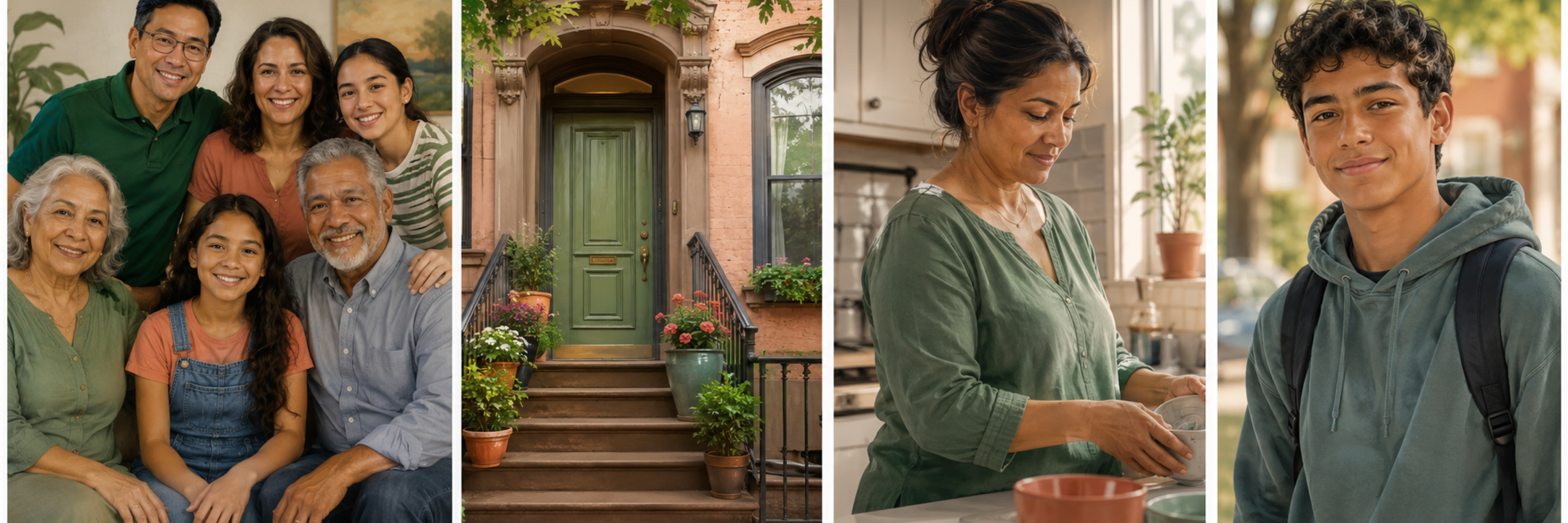
family / familiahome / hogarmother / madrebrother / hermano
1. Word Work / Trabajo con palabras
Read it. Tap the syllables. Trace it. Write it. / Lee. Separa las sílabas. Repasa. Escribe.
familyfam · i · lyfamiliafamily
homehomehogarhome
2. Do Now / Actividad inicial
Circle the people who may be in a family: sister · teacher · brother · mother · friend.
Day 2: Read and Understand / Leer y comprenderName: ____________________Date: ____________
I can: read a short text and find important details.
3. Mark the Text / Marca el texto
Circle the family words. Underline the place.
Encierra en un círculo las palabras sobre la familia. Subraya el lugar.
4. Read / Lee
Look first. What do the pictures tell you?
Mira primero. ¿Qué te dicen las imágenes?
Mira primero. ¿Qué te dicen las imágenes?
PLACEWhere?FAMILYWho?LANGUAGEWhat language?ACTIONWhat does he do?
Luis lives in Boston with his mother, grandmother, and two brothers. His family speaks Spanish at home. Luis helps his grandmother and plays soccer with his brothers.
Word bank / Banco de palabras: Boston · mother · grandmother · brothers · Spanish · plays soccer
5. Answer / Responde
- Where does Luis live?Sentence stem / Inicio de oración: Luis lives in ____.
- Who lives with Luis?Sentence stem / Inicio de oración: Luis lives with ____.
- What language does the family speak?Sentence stem / Inicio de oración: The family speaks ____.
- What does Luis do with his brothers?Sentence stem / Inicio de oración: Luis ____ with his brothers.
Day 2: My Response / Mi respuestaName: ____________________Date: ____________
6. My Work / Mi trabajo
Draw the people who are important to you. Label each person. Write: I live with ____. This is my ____.
ELD 1 · Entering / Inicial
I live with ____.
This is my ____.
ELD 2 · Emerging / Emergente
I live with ____.
An important person in my family is ____ because ____.
Draw / Dibuja
Write / Escribe
Exit Ticket / Ficha de salida
Complete: One important person in my life is my ____.
Day 3: My Languages and StrengthsName: ____________________Date: ____________
I can: I can name my languages and one personal strength.
Picture Words / Palabras con imágenes

language / idiomaspeak / hablarstrength / fortalezacreative / creativo/a
1. Word Work / Trabajo con palabras
Read it. Tap the syllables. Trace it. Write it. / Lee. Separa las sílabas. Repasa. Escribe.
languagelan · guageidiomalanguage
creativecre · a · tivecreativo/acreative
2. Do Now / Actividad inicial
Write or draw one thing you can do well.
Day 3: Read and Understand / Leer y comprenderName: ____________________Date: ____________
I can: read a short text and find important details.
3. Mark the Text / Marca el texto
Circle the languages. Underline the strengths.
Encierra en un círculo los idiomas. Subraya las fortalezas.
4. Read / Lee
Look first. What do the pictures tell you?
Mira primero. ¿Qué te dicen las imágenes?
Mira primero. ¿Qué te dicen las imágenes?
LANGUAGESWhich?LEARNINGWhat?STRENGTHSWhich?HELPHow?
Marta speaks Portuguese and Cape Verdean Creole. She is learning English. Marta is creative and helpful. She can draw, cook with her family, and help new students at school.
Word bank / Banco de palabras: Portuguese · Cape Verdean Creole · English · creative · helpful · new students
5. Answer / Responde
- Which languages does Marta speak?Sentence stem / Inicio de oración: Marta speaks ____ and ____.
- What language is she learning?Sentence stem / Inicio de oración: She is learning ____.
- What are two of Marta’s strengths?Sentence stem / Inicio de oración: Marta is ____ and ____.
- How does she help at school?Sentence stem / Inicio de oración: She helps ____.
Day 3: My Response / Mi respuestaName: ____________________Date: ____________
6. My Work / Mi trabajo
Make a strength shield. Add one language, one skill, and one character strength. Write: I speak ____. I can ____. I am ____.
ELD 1 · Entering / Inicial
I speak ____.
I can ____.
I am ____.
ELD 2 · Emerging / Emergente
I speak ____ and ____.
One of my strengths is ____ because I can ____.
Draw / Dibuja
Write / Escribe
Exit Ticket / Ficha de salida
Write one sentence beginning with “I am good at….”
Day 4: My Likes and GoalsName: ____________________Date: ____________
I can: I can describe something I like and one goal.
Picture Words / Palabras con imágenes

like / gustarsport / deportegoal / metapractice / practicar
1. Word Work / Trabajo con palabras
Read it. Tap the syllables. Trace it. Write it. / Lee. Separa las sílabas. Repasa. Escribe.
favoritefa · vor · itefavorito/afavorite
practiceprac · ticepracticarpractice
2. Do Now / Actividad inicial
Choose one: music · sports · art · reading. Write: I like ____.
Day 4: Read and Understand / Leer y comprenderName: ____________________Date: ____________
I can: read a short text and find important details.
3. Mark the Text / Marca el texto
Circle what Diego likes. Underline his action.
Encierra en un círculo lo que le gusta a Diego. Subraya la acción que realizará.
4. Read / Lee
Look first. What do the pictures tell you?
Mira primero. ¿Qué te dicen las imágenes?
Mira primero. ¿Qué te dicen las imágenes?
LIKESWhat?FAVORITEWhich class?GOALWhat goal?ACTIONWhat will he do?
Diego likes music and basketball. His favorite class is science. Diego has a goal for this year: he wants to improve his English reading. He will practice for fifteen minutes each day.
Word bank / Banco de palabras: music · basketball · science · improve reading · practice
5. Answer / Responde
- What does Diego like?Sentence stem / Inicio de oración: Diego likes ____ and ____.
- What is his favorite class?Sentence stem / Inicio de oración: His favorite class is ____.
- What is his goal?Sentence stem / Inicio de oración: His goal is to ____.
- How will he work toward the goal?Sentence stem / Inicio de oración: He will ____ each day.
Day 4: My Response / Mi respuestaName: ____________________Date: ____________
6. My Work / Mi trabajo
I like ____. My favorite ____ is ____. My goal is to ____. I will ____.
ELD 1 · Entering / Inicial
I like ____.
My goal is ____.
ELD 2 · Emerging / Emergente
I like ____ because ____.
My goal is to ____, and I will ____.
Draw / Dibuja
Write / Escribe
Exit Ticket / Ficha de salida
Name one goal and one action you can take.
Day 5: My Personal ProfileName: ____________________Date: ____________
I can: I can create and present a personal profile using complete sentences and visuals.
Picture Words / Palabras con imágenes
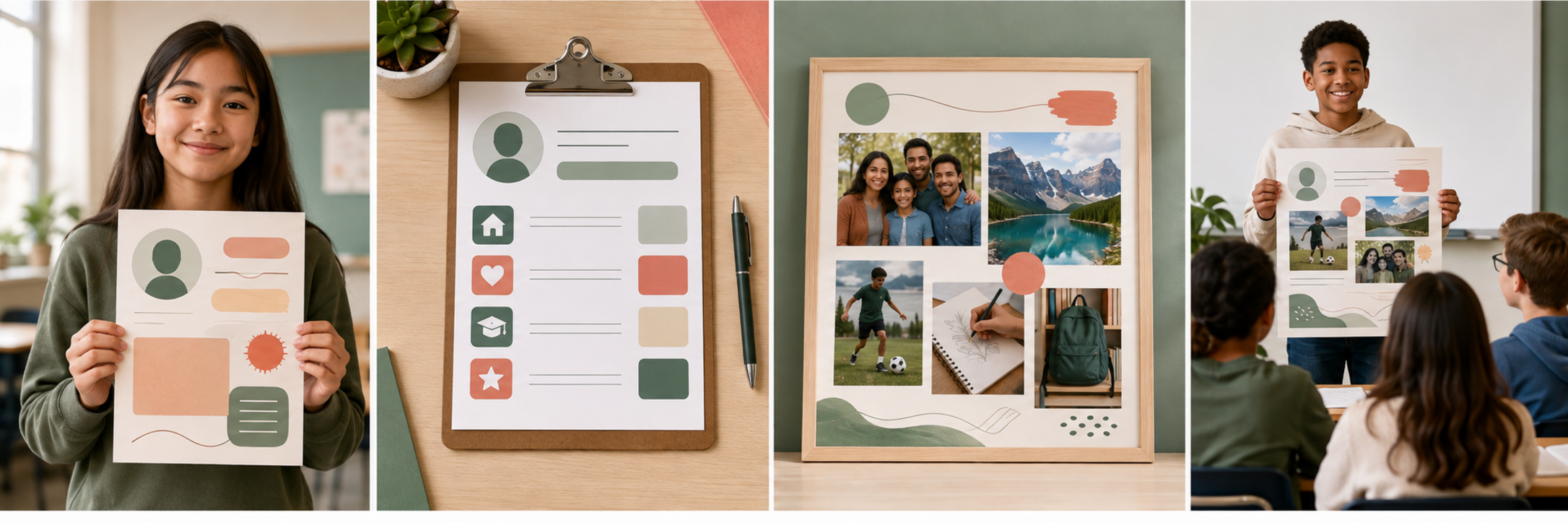
profile / perfilinformation / informaciónvisual / imagenpresent / presentar
1. Word Work / Trabajo con palabras
Read it. Tap the syllables. Trace it. Write it. / Lee. Separa las sílabas. Repasa. Escribe.
profilepro · fileperfilprofile
informationin · for · ma · tioninformacióninformation
2. Do Now / Actividad inicial
Review your work from Days 1–4. Star your best sentence.
Day 5: Read and Understand / Leer y comprenderName: ____________________Date: ____________
I can: read a short text and find important details.
3. Mark the Text / Marca el texto
Circle three profile details. Underline how pictures help.
Encierra en un círculo tres datos del perfil. Subraya cómo ayudan las imágenes.
4. Read / Lee
Look first. What do the pictures tell you?
Mira primero. ¿Qué te dicen las imágenes?
Mira primero. ¿Qué te dicen las imágenes?
PROFILEWhat is it?DETAILSWhat belongs?VISUALSHow do they help?
A personal profile tells important information about a person. It may include a name, country, languages, family, strengths, interests, and goals. Pictures and labels help the reader understand the information.
Word bank / Banco de palabras: information · name · country · languages · pictures · labels
5. Answer / Responde
- What does a personal profile do?Sentence stem / Inicio de oración: A personal profile ____.
- Name three details a profile may include.Sentence stem / Inicio de oración: A profile may include ____, ____, and ____.
- How can pictures help a reader?Sentence stem / Inicio de oración: Pictures help the reader ____.
Day 5: My Response / Mi respuestaName: ____________________Date: ____________
6. My Work / Mi trabajo
Create your profile poster. Include: name, country, language, important person, strength, interest, and goal. Add at least two visuals.
ELD 1 · Entering / Inicial
My name is ____.
I am from ____.
I speak ____.
I like ____.
My goal is ____.
ELD 2 · Emerging / Emergente
My name is ____, and I am from ____.
I speak ____. I am proud of ____ because ____.
My goal is to ____.
Draw / Dibuja
Write / Escribe
Exit Ticket / Ficha de salida
Self-check: I used 5+ sentences. I added visuals. I practiced. I spoke clearly.
Personal Profile Checklist
Simple scoring guide
4 · ReadyComplete, clear, and independently presented.
3 · ProgressingMostly complete with minor support.
2 · DevelopingSome required information; frequent support.
1 · BeginningVisuals or home language show understanding.
Heavy-support scaffold
Use picture choices, read every direction aloud, reduce writing to one frame at a time, and let students copy from a completed teacher model.
Core frames
My name is ____.
I am from ____.
I speak ____.
I like ____.
I can ____.
My goal is ____.
Teacher answer support
Reading answers appear directly in each short text. Accept copied words, labeled drawings, oral responses, or complete sentences according to proficiency.